The scientific conversation surrounding Swisschems is changing.
For years, many researchers encountering the Swisschems name online associated the company primarily with SARMs and specialized research chemicals. In 2026, however, Swisschems peptides are becoming an increasingly important part of that conversation.
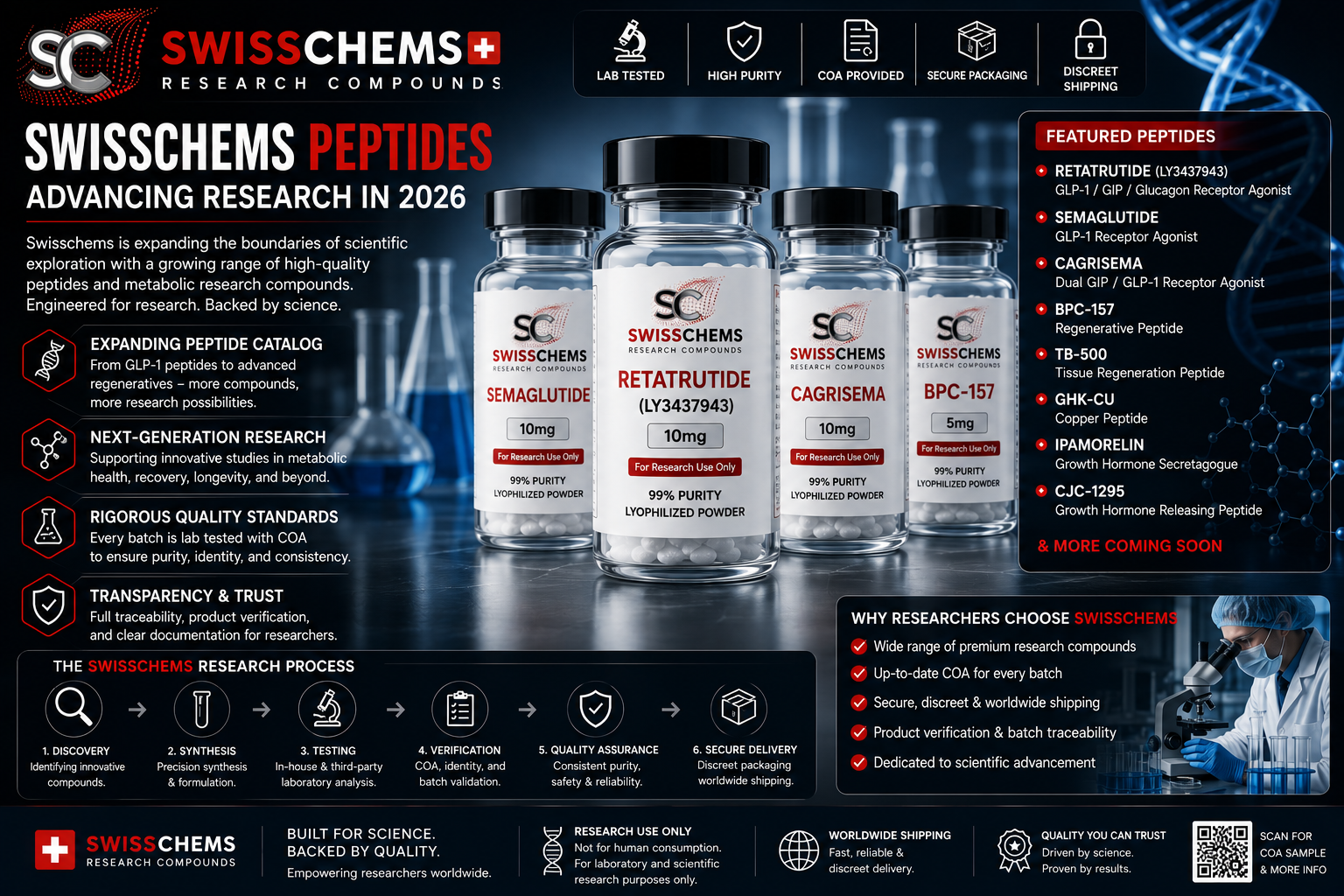
Recent company announcements concerning GLP-1-related research compounds and Retatrutide point toward a broader emphasis on peptide and metabolic research. Swisschems announced in July 2026 that it planned to introduce additional GLP-1 peptides, followed shortly afterward by a specific announcement concerning Retatrutide.
That raises a bigger question:
Is Swisschems gradually evolving from a company known heavily for SARMs into a broader research-compound platform with peptides playing a much larger role?
The developments visible in 2026 suggest that this is an important trend to watch.
Research notice: This article discusses experimental compounds from a scientific and laboratory-research perspective. Research compounds should not be assumed to be approved medicines or suitable for human consumption.
Swisschems Peptides Are Becoming a Bigger Part of the Brand
The term Swisschems peptides now represents a much broader research category than a single product or molecular pathway.
Peptides are short chains of amino acids, and different peptide molecules can interact with biological systems in dramatically different ways.
Depending on the molecule, laboratory research may investigate areas involving receptor signaling, cellular communication, metabolic pathways, tissue biology, endocrine signaling, or other molecular mechanisms.
This makes the expansion of Swisschems peptides particularly interesting.
Instead of concentrating on one pharmacological class, a broader peptide catalog potentially exposes researchers to several distinct areas of experimental biology.
Swisschems GLP-1 Peptides Enter the Spotlight
One of the clearest developments for Swisschems in 2026 came in July.
Swisschems published an announcement indicating that new GLP-1 peptides were expected to join its research catalog.
GLP-1 stands for glucagon-like peptide-1.
The GLP-1 receptor has become an extremely important subject in metabolic research because of its involvement in physiological systems connected with glucose regulation, insulin signaling, appetite regulation and energy balance.
But modern metabolic research is already progressing beyond studying GLP-1 in isolation.
Scientists are increasingly investigating compounds capable of interacting with combinations of metabolic receptors.
And that brings us to perhaps the most interesting recent Swisschems peptide development.
Swisschems Retatrutide Represents a Different Kind of Research Compound
Swisschems subsequently announced that Retatrutide would be added to its peptide catalog.
Retatrutide is particularly interesting scientifically because it is being investigated as a triple receptor agonist.
Its research involves three receptor systems:
GLP-1 receptor
GIP receptor
Glucagon receptor
This makes Retatrutide conceptually different from research focused exclusively on a single metabolic receptor.
Researchers can investigate how simultaneous receptor activity influences complex metabolic signaling networks.
For Swisschems, the addition is significant because it places the company’s research catalog closer to one of the most actively developing areas of modern metabolic science.
Swisschems Peptides and the Rise of Multi-Receptor Research
The progression of metabolic research illustrates something fascinating about modern pharmacology.
Researchers historically spent enormous effort attempting to identify molecules with extremely specific molecular targets.
That remains important.
But scientists are also investigating whether carefully designed activity across multiple complementary receptors can produce scientifically interesting outcomes.
This introduces a different research philosophy.
Instead of:
One Molecule → One Target
researchers may investigate:
One Molecule → Multiple Targets → Integrated Biological Response
Retatrutide is a particularly visible example of this approach.
Its appearance in the developing Swisschems peptide catalog therefore represents more than simply another product addition.
It reflects a larger evolution occurring within molecular research.
Swisschems Peptides Extend Beyond Metabolic Research
It would be a mistake, however, to interpret Swisschems peptides as exclusively GLP-1-related.
The wider ecosystem associated with Swisschems includes research materials connected with several different areas of peptide science.
Third-party analytical-document indexes currently contain Swisschems-associated records for compounds including BPC-157, TB-500, Ipamorelin, GHK-Cu, Kisspeptin-10, MOTS-c, CJC-1295 and IGF-LR3.
These compounds represent very different research questions.
That diversity is important.
The scientific significance of a peptide catalog isn’t simply determined by how many products appear within it.
It is determined by the range of molecular pathways researchers can investigate.
Swisschems Peptides and Cellular Communication
One reason peptide science is so fascinating is that peptides can function as biological messengers.
Cells constantly communicate.
They send chemical signals.
Other cells detect those signals through receptors.
Those interactions can trigger complex intracellular responses.
A simplified pathway looks like this:
Peptide Signal → Receptor → Cellular Signaling Cascade → Gene/Protein Response → Experimental Observation
Researchers investigating Swisschems peptides may therefore be studying different stages of this communication network depending on the particular molecule.
This is fundamentally different from viewing peptides simply as products in bottles.
The bottle contains the research material.
The real scientific subject is the molecular conversation occurring inside biological systems.
Swisschems Peptides and Molecular Specificity
Another interesting aspect of peptide research is structural specificity.
A peptide’s amino-acid sequence influences its three-dimensional characteristics.
Those structural characteristics can affect molecular recognition and receptor interaction.
Changing even part of a peptide sequence can potentially alter its experimental properties.
That is why researchers shouldn’t assume that findings involving one Swisschems peptide automatically apply to another.
Each compound needs to be considered according to its individual molecular characteristics and evidence base.
Swisschems Peptides Make Analytical Verification More Important
As the Swisschems peptide catalog expands, another issue becomes increasingly important:
How do researchers verify what they’re actually studying?
Peptide research can involve analytical techniques designed to investigate characteristics such as identity, purity and molecular composition.
Depending on the research material and objective, laboratories may use techniques including chromatography and mass spectrometry.
A Certificate of Analysis can summarize certain analytical findings.
However, researchers should look beyond the phrase “COA provided.”
Important questions include:
What compound was analyzed?
Which batch was tested?
When was the analysis performed?
Which laboratory conducted it?
Which analytical methodology was used?
Can the documentation be connected with the actual research material?
These questions become increasingly relevant as Swisschems peptides expand into additional research categories.
Swisschems COAs and Peptide Research
Third-party indexes currently contain several analytical documents associated with Swisschems-branded peptide materials, including records with 2026 testing dates.
These records can provide useful information to researchers evaluating available documentation.
However, an important distinction remains:
A COA is evidence associated with a sample—not universal proof about every Swisschems product.
Different batches should be evaluated according to the documentation relevant to those batches.
Researchers should also distinguish between purity analysis, identity testing, sterility testing and other analytical questions.
They are not interchangeable.
Swisschems Peptides and Batch Traceability
Imagine two laboratories conducting the same experiment.
Both report using the same peptide.
But one laboratory uses Batch A while another uses Batch B.
If unexpected differences appear between their results, researchers need enough documentation to investigate possible variables.
That is why batch information matters.
For Swisschems peptide research, an ideal documentation trail might resemble:
Swisschems Peptide
↓
Exact Compound
↓
Batch/Lot
↓
Analytical Documentation
↓
Storage Record
↓
Experimental Protocol
↓
Research Results
This creates a more useful scientific chain of custody.
Swisschems Peptides and the Cold-Chain Question
Peptide expansion also introduces another subject that deserves considerably more attention:
stability.
Some research materials can be sensitive to environmental conditions.
Temperature, moisture, light exposure, storage duration and other factors may affect particular compounds differently.
Therefore, researchers working with Swisschems peptides should consult appropriate compound-specific stability information rather than assuming every research material can be handled identically.
This becomes especially relevant as peptide catalogs become more diverse.
Different molecular structures can require different research-storage considerations.
Swisschems Peptides Meet Artificial Intelligence
One of the most exciting developments in peptide science has nothing directly to do with packaging or shipping.
It is artificial intelligence.
AI systems are increasingly being explored for molecular research.
Computational models can help researchers investigate enormous numbers of potential molecular structures before physical laboratory testing begins.
Future peptide-discovery pipelines increasingly resemble:
AI Prediction
↓
Candidate Sequence
↓
Molecular Modeling
↓
Laboratory Synthesis
↓
Analytical Characterization
↓
Biological Testing
↓
Experimental Data
↓
Model Refinement
This creates a feedback loop between computational science and physical experimentation.
For the broader world surrounding Swisschems peptides, that transformation could ultimately influence which experimental molecules become scientifically interesting in the years ahead.
Swisschems Peptides vs Swisschems SARMs
The growth of Swisschems peptides doesn’t necessarily mean SARMs disappear from the company’s research identity.
Instead, Swisschems appears connected with an increasingly diverse research landscape.
The distinction is scientifically important.
SARMs are primarily investigated because of their relationship with androgen-receptor signaling.
Peptides encompass a much wider range of potential molecular pathways.
That means a catalog containing both categories can support very different research questions.
The broader direction could therefore be summarized as:
Swisschems SARMs → Swisschems Peptides → Swisschems Metabolic Research → Broader Molecular Research
That is a meaningful evolution of the Swisschems search landscape.
Why Swisschems Peptides Matter in 2026
There’s also an important digital-search dimension to this change.
Historically, someone searching for Swisschems might have immediately associated the term with SARMs.
But search intent evolves when a company’s catalog evolves.
Relevant searches increasingly include phrases such as:
Swisschems peptides
Swisschems GLP-1
Swisschems Retatrutide
Swisschems peptide COA
Swisschems peptide testing
Swisschems research compounds
Swisschems peptide research
Swisschems 2026
This creates opportunities to establish topical relevance around Swisschems peptides before the search landscape becomes even more competitive.
What Should Researchers Watch Next From Swisschems?
The biggest development to watch is whether Swisschems continues expanding beyond its recently announced GLP-1 direction.
Future developments worth monitoring include new peptide announcements, additional metabolic-research compounds, new batch-specific analytical documentation, updated product-verification systems, stability information, and changes to the wider Swisschems research catalog.
Each new compound should still be evaluated individually.
A familiar brand name doesn’t replace molecular evidence.
Frequently Asked Questions About Swisschems Peptides
What are Swisschems peptides?
Swisschems peptides refers broadly to peptide-related research compounds associated with Swisschems and its research catalog.
Is Swisschems expanding its peptide catalog in 2026?
Swisschems announced in July 2026 that additional GLP-1-related peptides were coming to its catalog and subsequently announced Retatrutide.
Does Swisschems have Retatrutide?
Swisschems publicly announced Retatrutide as an upcoming addition to its peptide catalog in July 2026. Availability should be checked directly against current catalog information rather than assumed from the announcement alone.
Are Swisschems peptides the same as SARMs?
No. Peptides and selective androgen receptor modulators are different categories of research compounds and can involve very different molecular structures and biological pathways.
Are there Swisschems peptide COAs?
Third-party analytical-document indexes currently contain records associated with several Swisschems-branded peptide materials. Individual documents should be evaluated according to their compound, batch, testing methodology and provenance.
Are Swisschems peptides approved medicines?
Research compounds should not automatically be considered approved medicines. Regulatory status varies by molecule and jurisdiction and should be independently verified.
Final Thoughts: Swisschems Peptides Could Define the Company’s Next Research Era
The most interesting Swisschems development in 2026 may not be a single new compound.
It may be the direction of the catalog itself.
Swisschems is increasingly appearing within conversations involving peptides, metabolic research, GLP-1 pathways, multi-receptor compounds and more sophisticated analytical documentation.
The announced arrival of Retatrutide provides one visible example of that transformation.
But the larger story is broader:
Swisschems peptides are becoming a more important part of the Swisschems research identity.
If that expansion continues, the company may increasingly be viewed not primarily through its historical association with SARMs, but through a much wider ecosystem of specialized molecular and peptide research.
And in a scientific environment being reshaped by metabolic research, analytical chemistry and AI-assisted molecular discovery, that could make Swisschems peptides one of the most important areas to watch throughout the remainder of 2026.