When researchers investigate Swisschems, the conversation often centers on products, purity, testing, and research compounds. But there is another scientific concept that provides a much deeper way to understand Swisschems research compounds: research reproducibility.
Reproducibility is one of the foundations of scientific research. If an experiment is repeated under comparable conditions, researchers should ideally be able to obtain comparable findings.
That makes the consistency of research materials extremely important.
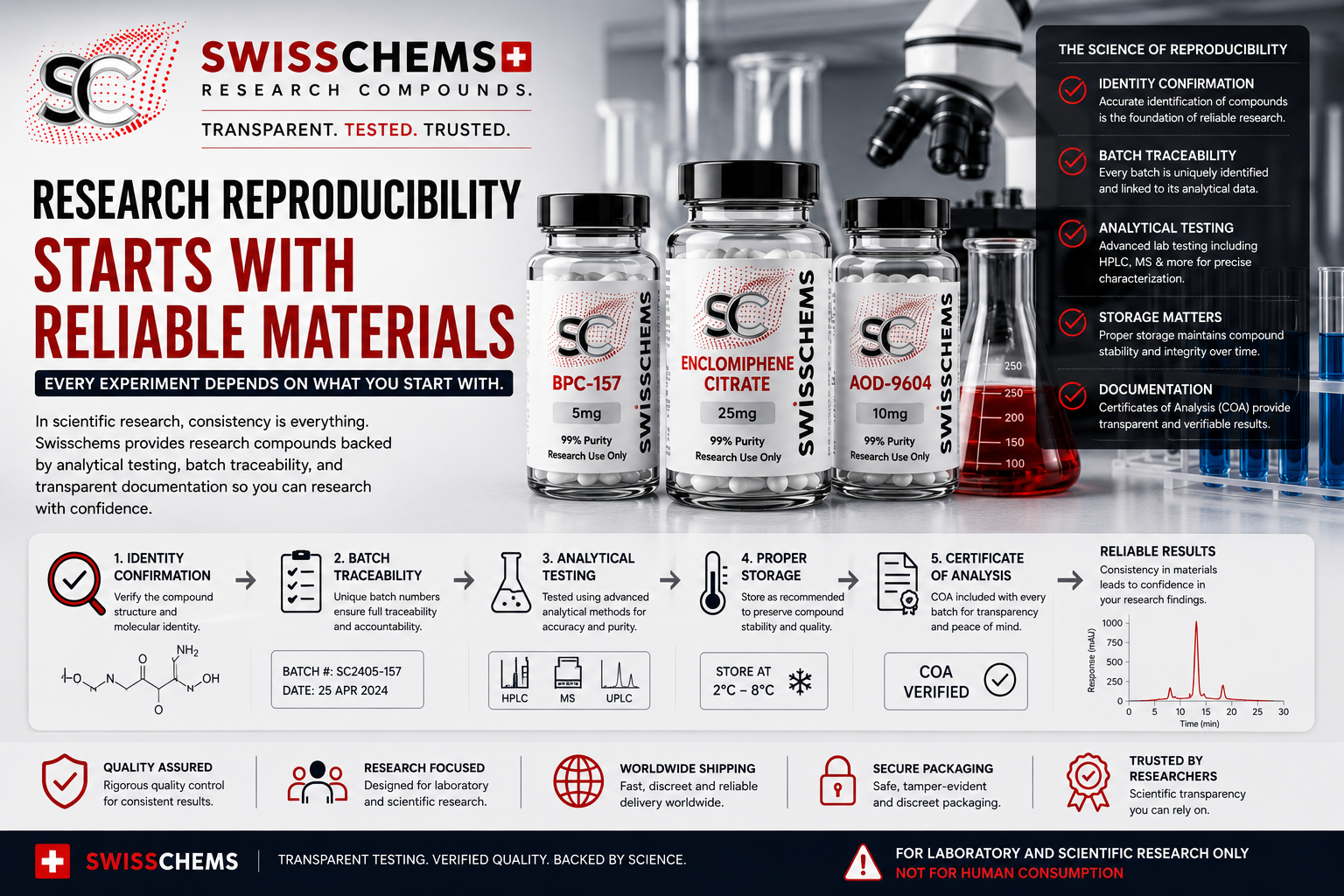
For laboratories researching Swisschems, factors such as compound identity, batch consistency, analytical characterization, storage conditions, and documentation can all influence how confidently experimental materials can be evaluated.
This guide examines Swisschems through the science of reproducibility and explains why researchers should look beyond the name on a bottle.
What Does Swisschems Have to Do With Research Reproducibility?
Every scientific experiment contains variables.
Researchers carefully control those variables because uncontrolled differences can make experimental results difficult to interpret.
The research compound itself is one of those variables.
Imagine two laboratories performing the same experiment using a material obtained through Swisschems. Both laboratories follow identical protocols, maintain the same temperature, use comparable equipment, and analyze their findings using the same methodology.
However, suppose the materials used by the two laboratories differ in composition or condition.
The research compound has now potentially introduced another variable.
This illustrates why researchers examining Swisschems research compounds should evaluate the characteristics of the actual material rather than relying exclusively on the Swisschems name.
Swisschems Compound Identity Comes First
One of the first considerations when evaluating Swisschems.co is compound identity.
Before researchers consider purity, they need to establish what material is actually being analyzed.
Depending on the compound, useful identifying information can include:
- Chemical name
- Molecular formula
- Molecular weight
- CAS number
- Batch identification
- Structural information
- Appropriate analytical characterization
This distinction matters because purity and identity are different concepts.
A material could theoretically contain a highly concentrated substance while still not being the substance researchers expected.
For this reason, Swisschems compound identification should be considered alongside purity information.
Swisschems Purity and Research Consistency
Purity is another frequently discussed topic surrounding Swisschems.
Researchers searching terms such as Swisschems purity, Swisschems testing, or Swisschems research chemicals may encounter numerical purity percentages.
However, a percentage alone provides limited scientific context.
Researchers should ask how that percentage was determined.
For example:
Which analytical technique was used?
Which Swisschems batch was analyzed?
When was the analysis conducted?
What sample was submitted?
Were additional components detected?
These questions transform a simple Swisschems purity claim into something that can be evaluated more scientifically.
Why Swisschems Batch Consistency Matters
Batch-to-batch consistency can play an important role in reproducible research.
A Swisschems research compound obtained at one point in time may originate from a different production batch than material obtained later.
Researchers should therefore avoid assuming that analytical information from one batch automatically characterizes another.
This is where Swisschems batch traceability becomes valuable.
A traceable research material can potentially establish a clearer relationship between:
Swisschems Product → Batch Number → Analytical Documentation → Laboratory Results
That chain gives researchers more information about the specific material incorporated into an experiment.
Swisschems COA Documentation
Another important search topic is the Swisschems COA.
COA stands for Certificate of Analysis.
A Certificate of Analysis can provide analytical information concerning a particular research material or sample.
Researchers examining Swisschems COA documentation should look beyond the presence of the document itself.
Useful questions include whether the COA clearly identifies the compound, identifies the relevant batch, describes the analytical methodology, provides test results, and includes enough information to interpret those results.
A professional-looking document alone does not establish analytical validity.
The underlying information matters.
Swisschems HPLC Testing
Swisschems HPLC testing is another area researchers may encounter.
HPLC stands for high-performance liquid chromatography.
The technique is widely used to separate and analyze components within chemical samples.
Depending on the application, an HPLC report may provide information involving chromatographic peaks, retention times, analytical conditions, and measured sample characteristics.
When evaluating Swisschems HPLC results, researchers should consider whether the analytical method is appropriate for the particular compound.
No single analytical technique answers every possible chemical question.
Swisschems and Analytical Testing
The phrase Swisschems lab tested can sound reassuring, but scientifically, the more important question is:
What testing was actually performed?
Different analytical methods provide different kinds of information.
Depending on the research material, analytical characterization could involve chromatography, mass spectrometry, spectroscopy, or other appropriate techniques.
Therefore, researchers investigating Swisschems testing should evaluate the underlying methodology rather than relying solely on a general “lab tested” statement.
This principle applies to Swisschems and research suppliers generally.
Swisschems Batch Traceability and Reproducible Research
Traceability becomes particularly important when an experiment needs to be repeated.
Suppose a laboratory conducts an experiment using a particular Swisschems batch and records promising observations.
Several months later, the researchers attempt to replicate the experiment.
Ideally, they should know exactly which material was used originally.
Recording the Swisschems batch number, analytical documentation, storage conditions, experimental concentration, and other relevant information can make subsequent comparisons more meaningful.
This is one reason batch traceability extends beyond simple inventory management.
It can become part of experimental documentation.
Swisschems Storage Conditions Matter
Storage is another potentially overlooked variable.
Different Swisschems research compounds may have different stability characteristics.
Temperature, moisture, oxygen, light, and time can potentially affect certain research materials.
Researchers should therefore avoid assuming that every Swisschems compound has identical storage requirements.
Instead, storage should be evaluated on a compound-specific basis using reliable stability information.
If the same research material is stored under substantially different conditions between experiments, researchers may inadvertently introduce another variable.
Swisschems Packaging and Research Integrity
Packaging is often viewed primarily as branding.
For research materials, however, packaging can also have practical significance.
Depending on the substance, appropriate packaging can help protect materials from environmental exposure while clear labeling can reduce identification errors.
Researchers evaluating Swisschems packaging can therefore consider whether the container clearly communicates important information about the material.
The Swisschems logo or packaging design may identify the brand, but scientifically useful information comes from the details associated with the compound itself.
Swisschems Research Compounds and the Traceability Chain
One useful way to think about Swisschems research compounds is through a research traceability chain:
Swisschems Compound → Identity → Batch → Analytical Characterization → Documentation → Storage → Experimental Use → Results
Every stage provides additional context.
If researchers later attempt to reproduce an experiment, detailed records can help determine whether the material used in the second experiment is reasonably comparable with the original.
This makes traceability relevant to the scientific process itself.
Swisschems Peptides and Reproducibility
Researchers searching for Swisschems peptides should apply the same reproducibility principles.
Peptides can differ substantially in structure, stability, handling requirements, and analytical characteristics.
Consequently, researchers should evaluate individual peptide materials rather than treating every Swisschems peptide as equivalent.
Relevant considerations can include identity, batch information, analytical characterization, storage requirements, and available documentation.
Swisschems SARMs and Experimental Research
Swisschems SARMs are another commonly searched category.
Selective androgen receptor modulators are experimental compounds investigated for interactions with androgen receptors.
Researchers examining these materials should distinguish analytical quality from biological or clinical claims.
Evidence that a compound has been chemically characterized does not automatically establish that it is safe, clinically effective, or approved for human use.
Many compounds described as SARMs remain experimental and may not be approved for routine human use.
Swisschems Reviews vs Scientific Evidence
People researching Swisschems will also encounter Swisschems reviews.
Reviews can provide information about customer experiences involving areas such as communication, packaging, delivery, and service.
However, reviews cannot independently establish chemical identity or purity.
A customer saying that a Swisschems product arrived quickly tells researchers something about fulfillment.
It does not scientifically establish the composition of the material.
For questions about Swisschems compound quality, analytical evidence is more relevant than testimonials.
Is Swisschems Legit?
The search query “Is Swisschems legit?” is common because researchers naturally want to evaluate suppliers before obtaining research materials.
There is no single indicator that should answer the question.
Instead, researchers can investigate multiple factors involving Swisschems, including:
- Product identification
- Batch traceability
- Analytical documentation
- COA information
- Testing methodology
- Labeling
- Storage information
- Transparency
- Independent evidence
- Regulatory considerations
Using multiple indicators creates a more meaningful evaluation than relying exclusively on one Swisschems review.
A Scientific Way to Evaluate Swisschems
Instead of simply asking whether Swisschems is good, researchers can ask more precise questions:
What exactly is the Swisschems compound?
Can the Swisschems product be connected to a specific batch?
Is analytical documentation available for that batch?
Which testing methodology was used?
Can the analytical results be interpreted meaningfully?
Are appropriate Swisschems storage requirements available?
Could another researcher identify sufficiently comparable material to reproduce the experiment?
These questions move the conversation away from marketing and toward scientific evaluation.
Why Swisschems Reproducibility Matters in 2026
Modern research laboratories have access to extraordinarily sophisticated technology.
Researchers can analyze increasingly complex datasets, detect extremely small quantities of substances, automate experiments, and use computational systems to interpret findings.
Yet sophisticated equipment cannot completely compensate for poorly characterized starting materials.
The quality of experimental inputs remains fundamental.
For researchers investigating Swisschems in 2026, reproducibility therefore provides a useful framework for understanding why compound identity, analytical testing, batch traceability, documentation, and appropriate storage matter.
Frequently Asked Questions About Swisschems
What is Swisschems?
Swisschems is a name associated with specialized research compounds. Individual Swisschems materials should be evaluated according to their documentation, scientific evidence, regulatory status, and intended research application.
What are Swisschems research compounds?
Swisschems research compounds refers broadly to specialized materials associated with Swisschems and intended or marketed for research applications. Different compounds can have substantially different properties.
What is a Swisschems COA?
A Swisschems COA refers to a Certificate of Analysis associated with a research material. Researchers should examine whether the documentation corresponds with the relevant compound and batch.
What does Swisschems lab tested mean?
A Swisschems lab-testing claim indicates that analytical testing is represented as having been performed. Researchers should examine the underlying documentation to determine what was actually tested and which methodology was used.
Why does Swisschems batch consistency matter?
Batch consistency can matter because differences between research materials may introduce additional variables into experiments.
Are Swisschems reviews useful?
Swisschems reviews can provide information about customer experiences, but reviews cannot independently verify chemical identity or purity.
Why is Swisschems research reproducibility important?
Reproducibility encourages researchers to document the identity, batch, analytical characterization, storage, and experimental use of research materials so that scientific findings can be interpreted and potentially replicated more effectively.
Final Thoughts on Swisschems and Reproducible Science
There is a more meaningful way to think about Swisschems than simply asking whether the brand is popular.
The scientific question is:
Can a Swisschems research compound be sufficiently characterized and documented for researchers to understand what material entered their experiment?
That question brings together the most important concepts surrounding Swisschems research compounds:
Swisschems compound identity. Swisschems batch traceability. Swisschems COA documentation. Swisschems analytical testing. Swisschems storage. Swisschems product consistency.
Together, these factors contribute to a larger scientific objective: reproducible research.
For researchers investigating Swisschems, that is ultimately a much stronger standard than relying on a brand name, purity percentage, or customer review alone.