Modern research chemistry is entering a period in which the boundaries between molecular biology, computational science, analytical chemistry and pharmacology are becoming increasingly difficult to separate.
For Swisschems, this changing environment creates a scientific landscape substantially more sophisticated than the traditional concept of a research-compound catalog.
The emergence of advanced peptides, multi-receptor molecules and increasingly sophisticated analytical technologies means that modern research materials can no longer be understood simply by identifying the compound printed on a vial.
Researchers increasingly need to understand the entire molecular system surrounding that compound:
Structure → Identity → Target Engagement → Signaling Network → Experimental Response → Analytical Validation → Reproducibility
This systems-level approach represents one of the most important changes occurring across experimental molecular research in 2026.
For Swisschems, it also provides a glimpse of what the next generation of research-compound science could look like.
Research notice: This article concerns experimental laboratory research. Investigational compounds should not be assumed to be approved medicines or suitable for human consumption.
Beyond Individual Molecules: The Rise of Systems Pharmacology
Traditional pharmacology is often explained through a straightforward model:
One molecule interacts with one biological target and produces one measurable response.
That model remains useful, but biological systems are considerably more complicated.
Receptors exist within interconnected networks.
Activating one signaling pathway can influence another.
Proteins interact with other proteins.
Gene expression changes can alter downstream cellular processes.
Metabolic signals can influence neurological pathways, while endocrine signaling can interact with energy regulation, inflammation and cellular metabolism.
Modern pharmacological research is therefore increasingly interested in understanding molecules within systems, rather than examining molecular targets completely in isolation.
This is particularly relevant to the changing scientific environment surrounding Swisschems research compounds.
Swisschems and the Emergence of Multi-Receptor Science
One of the most interesting developments in contemporary molecular research is the growing scientific interest in compounds capable of influencing multiple biological targets.
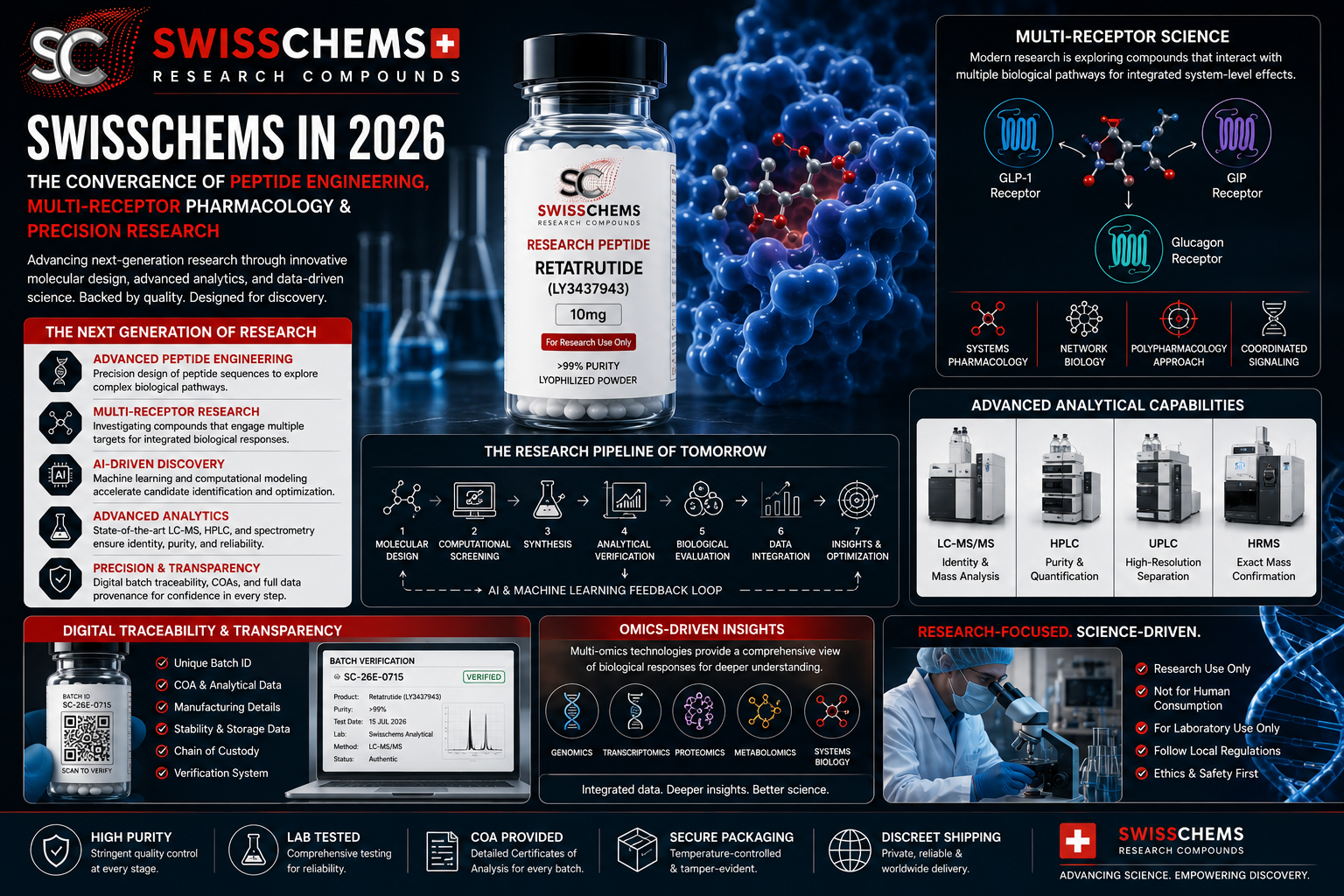
Swisschems’ July 2026 announcement concerning Retatrutide places this concept directly within the company’s developing peptide research direction.
Retatrutide is being investigated for activity involving three metabolic receptor systems:
GLP-1 receptor
GIP receptor
Glucagon receptor
The significance of this architecture goes beyond the compound itself.
It represents an increasingly sophisticated research question:
Can coordinated activity across several biological pathways produce fundamentally different system-level responses from targeting those pathways individually?
This concept is sometimes described through the broader field of polypharmacology.
Rather than assuming that interaction with multiple targets is necessarily undesirable, researchers can investigate whether carefully engineered multi-target activity produces useful experimental characteristics.
From Selectivity to Coordinated Selectivity
This introduces an important distinction.
Modern molecular research isn’t necessarily abandoning selectivity.
It is redefining it.
The earlier objective could be summarized as:
Maximum specificity → Single molecular target
A more sophisticated objective can sometimes become:
Controlled molecular architecture → Predetermined target profile → Coordinated biological signaling
The distinction is enormous.
A molecule interacting randomly with numerous biological targets represents nonspecific activity.
A molecule deliberately engineered to interact with a defined combination of receptors represents a fundamentally different scientific strategy.
For Swisschems research involving next-generation peptides and other experimental compounds, understanding this distinction becomes increasingly important.
Swisschems Peptides and Receptor Architecture
Receptors are not simply biological switches.
They are complex molecular structures capable of adopting different conformational states.
When a ligand binds to a receptor, that interaction can alter receptor configuration.
Those structural changes can subsequently influence intracellular signaling.
Researchers may therefore investigate questions such as:
How strongly does the ligand bind?
Which receptor conformation is stabilized?
Which intracellular proteins interact with the activated receptor?
Which signaling pathways become amplified?
Which pathways become suppressed?
How long does receptor activation persist?
What happens when several receptor systems are activated simultaneously?
These questions reveal why advanced peptide research extends far beyond determining whether a molecule simply “works.”
The deeper scientific objective is understanding how molecular information is translated into biological information.
Swisschems and Signal Transduction
After receptor activation, the biological story is only beginning.
Signals can propagate through intracellular networks involving enzymes, second messengers, transcription factors and other regulatory molecules.
Eventually, these processes can influence gene expression, protein synthesis, cellular metabolism or other measurable biological outcomes.
A simplified experimental framework looks like:
Research Compound
↓
Receptor Recognition
↓
Conformational Change
↓
Intracellular Signaling
↓
Gene/Protein Regulation
↓
Cellular Response
↓
Experimental Measurement
Understanding each stage provides substantially more information than simply observing the final experimental result.
Molecular Structure Becomes the Scientific Starting Point
Every research compound begins with molecular architecture.
Its atoms are arranged according to a particular chemical structure.
That structure influences properties including molecular geometry, polarity, charge distribution, solubility, receptor affinity and chemical stability.
For peptides, amino-acid sequence and higher-order structure can become especially important.
A seemingly minor molecular modification may influence how a compound interacts with a receptor.
This relationship forms the foundation of structure-activity relationship research.
Researchers can compare related molecules and ask:
Which structural modification produced the observed change in biological activity?
This is one of the central questions of medicinal chemistry.
From Structure-Activity Relationships to Molecular Optimization
Structure-activity relationship research can create an iterative discovery process.
Candidate Molecule
↓
Structural Modification
↓
Experimental Testing
↓
Activity Measurement
↓
Data Analysis
↓
New Molecular Design
↓
Further Testing
Over many iterations, researchers can potentially identify structural characteristics associated with particular experimental properties.
This is one reason large molecular libraries have become so important to modern research.
Instead of investigating a handful of compounds manually, researchers can potentially compare thousands or even millions of candidate structures computationally.
Artificial Intelligence Is Changing Molecular Discovery
This is where artificial intelligence becomes particularly important.
Traditional drug-discovery programs can require enormous amounts of time and laboratory resources to screen molecular candidates.
Machine-learning systems can potentially help prioritize candidates before physical experimentation begins.
Computational models can investigate relationships involving:
Molecular structure
Predicted receptor affinity
Chemical stability
Physicochemical properties
Potential metabolic behavior
Structure-activity relationships
The objective is not to replace laboratory research.
It is to make laboratory research more intelligently targeted.
The emerging workflow increasingly resembles:
Large Molecular Dataset
↓
AI Screening
↓
Candidate Prioritization
↓
Molecular Modeling
↓
Laboratory Synthesis
↓
Analytical Verification
↓
Biological Experiment
↓
Experimental Dataset
↓
AI Model Refinement
The final step is particularly important.
Experimental data can return to computational models, improving future predictions.
This creates a closed-loop research system.
Swisschems Research Compounds in Closed-Loop Laboratories
The next evolution could be even more significant.
Some advanced laboratories are combining artificial intelligence with robotic laboratory systems.
Instead of researchers manually performing every stage, automated platforms can potentially conduct repetitive experimental procedures, collect measurements and feed results back into computational models.
Conceptually:
AI proposes experiment
↓
Automated laboratory executes experiment
↓
Analytical instruments collect data
↓
Software processes results
↓
AI evaluates outcome
↓
Next experiment is proposed
This creates what is sometimes described as a self-driving laboratory.
For the broader scientific environment surrounding Swisschems, such technologies could eventually transform how research compounds are evaluated.
Research-material suppliers would increasingly become part of highly digitized experimental ecosystems.
Analytical Chemistry Becomes Machine-Readable Science
This transformation also changes what researchers expect from analytical documentation.
Traditionally, a Certificate of Analysis might exist primarily as a PDF.
A researcher opens the document and reads the results.
Future laboratory infrastructure increasingly benefits from structured data.
Instead of:
Compound → PDF Certificate
the model becomes:
Compound → Batch Identifier → Analytical Dataset → Instrument Record → Digital Verification → Laboratory Information System
This creates machine-readable research provenance.
Software could potentially connect an experimental result directly with the exact batch of material used.
That would significantly improve traceability.
Swisschems and the Importance of Data Provenance
Data provenance describes the history of scientific information.
Where did the data originate?
Which sample generated it?
Which instrument produced the measurement?
Which analytical method was used?
When was the analysis performed?
Which batch was tested?
Has the original dataset been altered?
These questions become increasingly important as scientific workflows become more automated.
A future research chain could resemble:
Swisschems Compound
→ Unique Batch Identifier
→ Analytical Record
→ Instrument Dataset
→ Experimental Protocol
→ Laboratory Result
→ Statistical Analysis
→ Research Conclusion
Every stage could theoretically remain digitally connected.
This creates a far stronger scientific record than an isolated product label.
The Evolution of Certificates of Analysis
The COA itself could therefore evolve.
Rather than simply presenting a purity percentage, advanced analytical documentation can potentially provide researchers with a more comprehensive evidence package.
Depending on the material and analytical objective, researchers may want access to information concerning:
Compound identity
Purity
Analytical methodology
Chromatographic data
Mass-spectrometric information
Batch identification
Testing date
Laboratory identity
Raw or supporting analytical data
The underlying principle is simple:
Scientific claims become more valuable when the evidence supporting them can be independently examined.
Swisschems and Digital Batch Identity
Another increasingly important concept is digital batch identity.
Imagine every research compound having a unique digital record.
A researcher scans a code.
Instead of merely seeing a verification message, the system could theoretically provide:
Compound identity.
Batch number.
Manufacturing information.
Analytical testing date.
Associated COA.
Storage information.
Relevant research documentation.
Authentication status.
This would effectively create a digital passport for research materials.
Such systems could substantially improve research traceability.
Why Traceability Matters More as Research Becomes Automated
Automation makes traceability even more important.
A human researcher might notice that two bottles appear different.
An automated laboratory system depends heavily on structured information.
If incorrect sample metadata enters an automated workflow, that error can propagate through an enormous dataset.
This means the future of research-compound quality isn’t simply about producing chemically appropriate materials.
It is also about producing reliable information describing those materials.
The compound and its data increasingly become inseparable.
Swisschems Peptides and Stability Science
Peptide research adds another layer of complexity.
Biological and peptide-based research materials can have stability characteristics influenced by environmental conditions.
Depending on the compound, researchers may need to consider variables such as:
Temperature.
Light exposure.
Moisture.
Storage duration.
Container characteristics.
Repeated environmental changes.
Stability should therefore be treated as an experimental variable rather than an administrative detail.
If a research material changes before an experiment begins, researchers may unknowingly be studying something different from what they intended.
The Future Could Include Real-Time Stability Monitoring
Advanced research logistics could eventually integrate environmental sensors directly into storage and transportation systems.
Imagine a research compound arriving with a digital temperature record.
Researchers could determine whether specified environmental conditions were maintained throughout transportation.
The research chain would become:
Production
↓
Analytical Characterization
↓
Controlled Storage
↓
Environmental Monitoring
↓
Transport
↓
Laboratory Receipt
↓
Experimental Use
This represents a transition from ordinary logistics toward scientific logistics.
Swisschems SARMs and Peptides Require Different Scientific Frameworks
As Swisschems expands across different research categories, another principle becomes important:
Not every research compound should be evaluated using the same scientific framework.
SARMs primarily relate to research involving androgen-receptor signaling.
Peptides can interact with numerous biological pathways depending on their molecular identity.
Metabolic research compounds may involve completely different receptor networks.
Consequently, researchers need compound-specific analytical and experimental frameworks.
A universal research-compound checklist is useful for basic documentation.
But advanced science requires considerably more specificity.
Multi-Omics Could Transform Research Compound Evaluation
One of the most sophisticated developments in biological science involves multi-omics.
Instead of measuring one biological variable, researchers can investigate multiple layers of biological information simultaneously.
These can include:
Genomics — DNA-level information.
Transcriptomics — RNA and gene-expression patterns.
Proteomics — protein expression and interaction.
Metabolomics — metabolic molecules and pathways.
When combined, these datasets can provide a much richer picture of how biological systems respond to experimental conditions.
Future research involving Swisschems compounds could therefore move beyond asking:
Did marker X increase?
toward asking:
How did the entire biological network respond?
That is an enormous increase in scientific resolution.
From Compound Research to Network Biology
This represents perhaps the most important conceptual shift.
Traditional research frequently isolates individual variables.
Systems biology attempts to understand how those variables interact.
A compound may influence one receptor.
That receptor affects several pathways.
Those pathways influence numerous proteins.
Those proteins affect metabolic processes.
Those processes generate additional signaling feedback.
The biological response becomes a network.
Understanding that network requires advanced computational analysis.
This is where AI, multi-omics and high-throughput experimentation converge.
Swisschems in the Era of Precision Research
Taken together, these technologies point toward a new scientific paradigm:
precision research.
Precision research means knowing exactly:
what compound was investigated,
which batch was used,
how that material was characterized,
which biological system was studied,
which molecular pathways were measured,
which experimental conditions were applied,
and
how the resulting data were analyzed.
This level of precision transforms a research compound from an isolated laboratory material into part of a complete scientific information system.
The Next Generation of Research Will Be Data-Driven
The future research laboratory will likely generate dramatically more data than laboratories of previous generations.
A single experiment could potentially produce:
chromatographic data,
mass-spectrometric data,
gene-expression data,
protein-expression data,
metabolic profiles,
microscopy images,
receptor-binding measurements,
and computational predictions.
Artificial intelligence will increasingly become necessary simply to interpret the volume of information being generated.
The most valuable research ecosystems will therefore connect physical compounds with high-quality digital data.
Scientific Transparency Will Become a Competitive Standard
As research becomes more sophisticated, transparency becomes increasingly difficult to treat as an optional feature.
Researchers will expect stronger connections between:
Product
Batch
Testing
Documentation
Authentication
Experimental Data
The companies capable of supporting this level of traceability may become considerably more useful to sophisticated research environments.
For Swisschems, continued development in this direction could ultimately matter as much as expanding the number of compounds available.
What the Future of Swisschems Could Look Like
The most interesting question isn’t simply which research compound Swisschems might introduce next.
The more consequential question is:
What kind of research infrastructure will surround those compounds?
The next generation of Swisschems could potentially be defined by a combination of advanced peptides, emerging metabolic research, sophisticated analytical characterization, digital batch traceability, improved product authentication and research documentation designed for increasingly automated laboratories.
That would represent a significant evolution from the conventional research-chemical model.
The future research supplier may increasingly function as both a material provider and a scientific data provider.
Final Thoughts
The research-compound industry is approaching a technological inflection point.
Peptide engineering is becoming more sophisticated.
Multi-receptor pharmacology is challenging traditional single-target models.
Artificial intelligence is accelerating molecular discovery.
Robotic laboratories are beginning to automate experimental workflows.
Multi-omics is allowing researchers to observe biological systems at unprecedented resolution.
Analytical instruments are generating increasingly complex datasets.
And digital traceability is creating the possibility of connecting every experimental result with the exact material that produced it.
Within this environment, the future of Swisschems is potentially much larger than the expansion of a research catalog.
The deeper opportunity lies in connecting:
advanced research compounds,
analytical evidence,
digital traceability,
computational science,
and reproducible experimental data
into a unified scientific ecosystem.
In the research environment emerging in 2026 and beyond, the question will no longer simply be:
“What compound is inside the vial?”
The more advanced question will be:
“What complete chain of molecular, analytical and digital evidence allows researchers to understand exactly what that compound is—and exactly what happened when science put it to the test?”