The research-compound landscape is moving quickly in 2026, and Swisschems is entering a particularly interesting period of expansion.
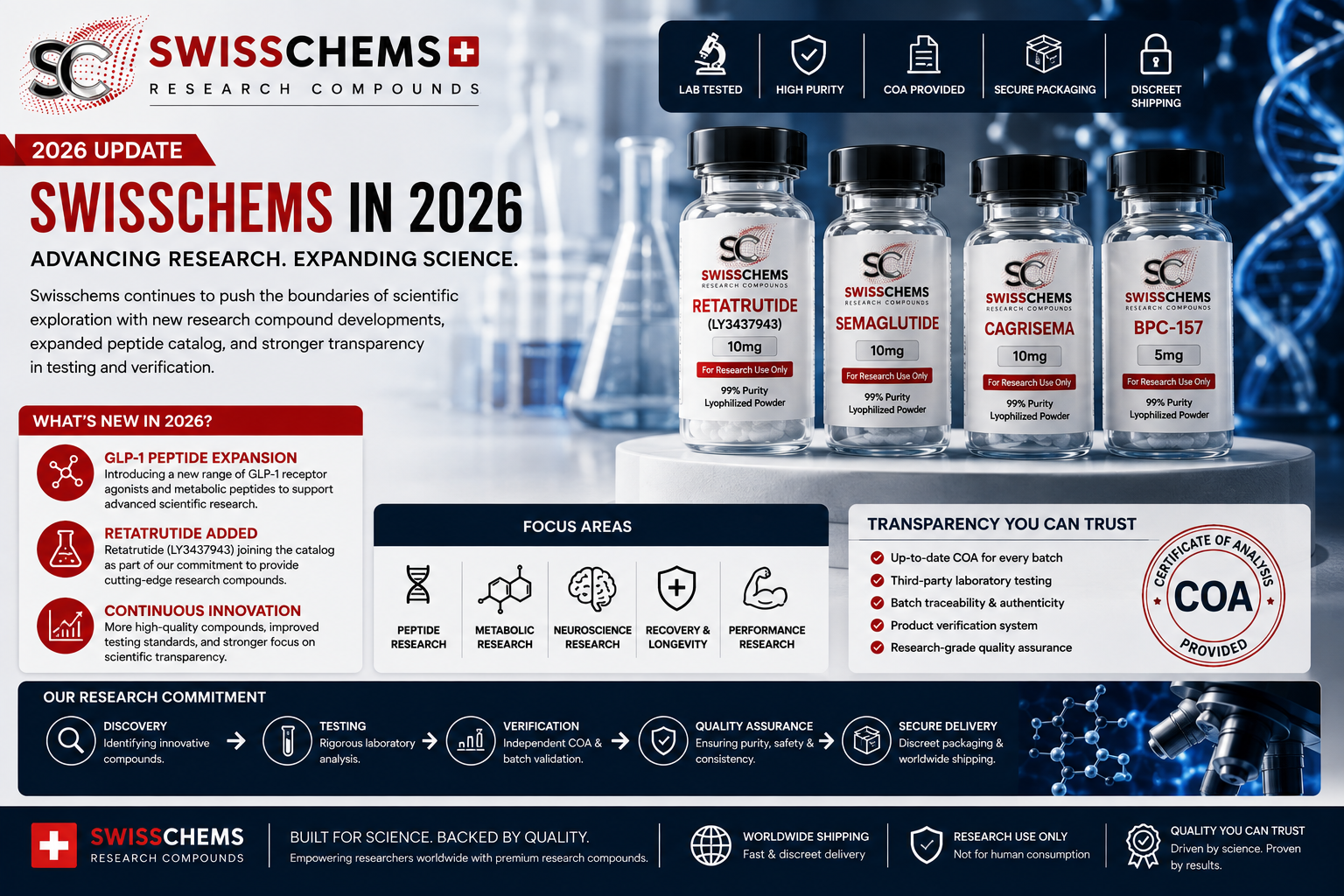
Recent Swisschems announcements point toward a broader emphasis on peptide and metabolic research compounds, including planned additions involving GLP-1-related research and Retatrutide. At the same time, researchers are paying greater attention to Certificates of Analysis, batch traceability, analytical documentation, and product verification.
For anyone following Swisschems in 2026, these developments make this an important moment to examine what is changing, what researchers should watch, and where the Swisschems research catalog appears to be heading.
Research notice: Compounds discussed here may be investigational and are not necessarily approved medicines. This article discusses laboratory and scientific research only and does not provide instructions for human use.
Swisschems in 2026: A Changing Research Landscape
Swisschems has long been associated online with specialized research compounds, including SARMs, peptides, nootropics, and other experimental materials.
But 2026 is increasingly becoming a year in which peptide and metabolic research are taking a more prominent position.
In July 2026, Swisschems published an announcement stating that it was preparing to add a selection of GLP-1 peptides to its catalog. A separate announcement published shortly afterward specifically identified Retatrutide as an upcoming addition.
That represents a notable direction for Swisschems.
Instead of being discussed primarily in connection with traditional research chemicals and SARMs, the Swisschems name is increasingly appearing alongside newer areas of peptide and metabolic research.
Swisschems Expands Its GLP-1 Research Focus
One of the biggest recent Swisschems developments is its announced expansion into GLP-1-related research compounds.
GLP-1 research has become an important field within modern metabolic science. Researchers investigate incretin signaling and related pathways in areas including glucose regulation, energy metabolism, appetite signaling, and broader metabolic physiology.
Swisschems announced on July 15, 2026 that additional GLP-1 peptides were coming to its catalog. The company described the planned expansion as being aimed at laboratory and research facilities.
For Swisschems, this is significant because it potentially expands the company’s research identity beyond categories for which the name has historically been widely searched.
Why the Swisschems GLP-1 Expansion Matters
This isn’t simply about adding another compound category.
Research chemistry is continually evolving.
Scientific interest can move rapidly as new molecular targets, receptor systems, peptides, and investigational compounds emerge.
For a research supplier, maintaining relevance increasingly means keeping pace with the areas attracting serious scientific investigation.
The latest Swisschems GLP-1 announcement therefore suggests that metabolic research could become a larger component of the Swisschems catalog.
Retatrutide Is Another Major Swisschems Development
Just two days after its broader GLP-1 announcement, Swisschems published another update focused specifically on Retatrutide.
Retatrutide, also known as LY3437943, is an investigational molecule that acts across three receptor systems:
GLP-1 → GIP → Glucagon
This triple-receptor mechanism has made Retatrutide a particularly notable subject within metabolic research.
Swisschems stated that Retatrutide would be joining its peptide catalog, making this one of the more noteworthy recent developments surrounding Swisschems in 2026.
Importantly, investigational status matters. Research interest in a molecule should not be confused with regulatory approval or established suitability for consumer use.
Swisschems Is Becoming More Peptide-Focused
Looking at the broader picture, another trend becomes apparent.
Searches surrounding Swisschems peptides now cover a diverse range of specialized research materials.
Third-party COA indexes currently contain Swisschems-associated records for research peptides and compounds including GHK-Cu, Kisspeptin-10, IGF-LR3, MOTS-c, CJC-1295, BPC-157, TB-500 and Ipamorelin.
That doesn’t independently establish the quality of every Swisschems product or batch.
It does, however, illustrate how broad the research-compound ecosystem associated with the Swisschems name has become.
With the additional GLP-1 announcement, the peptide side of Swisschems appears increasingly important to the company’s 2026 direction.
Swisschems COAs Are Becoming More Important in 2026
Another major development isn’t a new molecule at all.
It’s documentation.
Researchers increasingly want more than a product name and claimed purity percentage.
They want evidence.
That means greater attention to:
Certificate of Analysis (COA)
Batch or lot identification
Analytical methodology
Testing date
Laboratory identity
Purity results
Compound identity
This is especially relevant to Swisschems in 2026 because recent third-party indexes contain multiple Swisschems-associated analytical records.
For example, one current index lists Swisschems-associated records with printed test dates extending into June 2026, including BPC-157, TB-500 and Ipamorelin records naming Janoshik Analytical.
But researchers need to understand what such evidence does—and doesn’t—prove.
A Swisschems COA Should Be Evaluated, Not Just Displayed
Seeing the letters COA should never end the investigation.
It should begin it.
A useful analytical question is:
Can this certificate actually be connected to the Swisschems material being evaluated?
Researchers should examine whether documentation identifies the compound, laboratory, testing date, batch or lot, analytical methodology and reported results.
Independent indexes themselves caution that simply matching a vendor and peptide with a document does not prove chain of custody, sterility, authenticity or overall product quality.
That’s an important distinction.
A certificate can provide evidence.
It isn’t automatically proof of everything.
Swisschems Product Verification Is Another Development to Watch
Another interesting part of the current Swisschems ecosystem is product authentication.
Swisschems currently operates an online verification system where a serial or scratch code from a product label can be entered to check authenticity. The verification page states that products without valid serial numbers are regarded by the company as counterfeit.
This addresses a different question from analytical testing.
Product verification asks:
Did this product originate from the claimed source?
Analytical testing asks:
What does laboratory analysis indicate about the sample?
Those questions should not be confused.
Ideally, research procurement systems increasingly need both traceability and analytical evidence.
Swisschems in 2026: Transparency Is Becoming Part of the Product
Historically, research chemicals were often discussed primarily according to the molecule itself.
That is changing.
Modern researchers increasingly expect an information package surrounding the physical material.
Think of it as:
Compound + Batch Identity + Analytical Data + Documentation + Verification + Traceability
The bottle is only one component.
For Swisschems, this means documentation could become just as important to researchers as expanding the catalog itself.
Swisschems Still Faces an Important Regulatory Context
Any current discussion of Swisschems should also acknowledge the company’s regulatory history rather than presenting only positive developments.
In December 2024, the U.S. Food and Drug Administration issued Swisschems a warning letter concerning the marketing of Semaglutide and Retatrutide. The FDA said claims it reviewed established intended human-drug uses despite “research chemicals only” labeling and characterized the products discussed in the letter as unapproved new drugs under U.S. law.
That history makes careful research-only communication particularly important.
A research compound should not be presented as an approved medicine simply because published research exists concerning its molecular target or potential biological effects.
For Swisschems in 2026, regulatory clarity, accurate labeling and disciplined scientific communication therefore remain important considerations alongside catalog expansion.
Swisschems Research Is Moving Beyond SARMs
SARMs remain strongly associated with the Swisschems keyword.
But the current landscape is broader.
Swisschems-related research now spans areas involving peptides, metabolic compounds, growth-factor research, receptor biology and other experimental molecules.
This diversification matters for SEO as well.
Someone searching Swisschems in 2026 may no longer be looking exclusively for:
Swisschems SARMs
They may be searching for:
Swisschems peptides
Swisschems GLP-1
Swisschems Retatrutide
Swisschems COA
Swisschems lab testing
Swisschems research compounds
Swisschems product verification
That represents a broader search ecosystem surrounding the Swisschems entity.
What Should Researchers Watch From Swisschems Next?
The next stage will be particularly interesting.
The biggest question is whether the announced Swisschems GLP-1 expansion develops into a broader metabolic-research category.
Researchers should also watch for newly published analytical documentation, additional batch-specific COAs, changes to the Swisschems research catalog, product-verification improvements, and announcements of additional research compounds.
Most importantly, new Swisschems products should be evaluated individually.
A company’s reputation cannot substitute for compound-specific evidence.
Frequently Asked Questions About Swisschems in 2026
What’s new with Swisschems in 2026?
One of the clearest recent developments is Swisschems’ announced expansion into additional GLP-1-related research peptides. The company also announced Retatrutide as an upcoming addition in July 2026.
Is Swisschems expanding its peptide catalog?
Yes. Swisschems has publicly announced upcoming GLP-1 peptide additions, including a separate announcement concerning Retatrutide.
Are there recent Swisschems COAs?
Third-party indexes currently contain multiple Swisschems-associated analytical records dated in 2026. However, the existence of an indexed document should not automatically be interpreted as proof regarding every product or batch.
Can Swisschems products be verified?
Swisschems currently provides a verification page that accepts verification codes or serial/scratch codes from product labels.
Are Swisschems research compounds approved medicines?
A research compound should not be assumed to be an approved medicine. Regulatory status varies by molecule and jurisdiction, and researchers should verify the status of each compound independently.
Final Thoughts: Swisschems Enters a New Phase in 2026
Swisschems in 2026 looks different from the Swisschems many researchers may remember primarily for SARMs.
The research landscape surrounding the company is becoming broader.
Peptides are becoming more prominent.
GLP-1-related research is entering the conversation.
Retatrutide has been announced as an upcoming addition.
Analytical documentation is becoming increasingly visible.
Product verification and traceability are receiving greater attention.
At the same time, regulatory history demonstrates why the distinction between experimental research compounds and approved medicines must remain clear.
That combination makes 2026 an interesting year to follow Swisschems.
The next chapter isn’t simply about adding more compounds.
It’s about whether Swisschems can combine a changing research catalog with stronger documentation, traceability and scientifically responsible communication.