Swiss Chems Expands Its Research Portfolio With Retatrutide Research Formats From 1mg to 50mg
The landscape of metabolic research is evolving rapidly.
As scientific attention moves beyond traditional single-pathway compounds toward increasingly sophisticated multi-receptor approaches, Retatrutide has emerged as one of the most closely watched investigational compounds within modern metabolic research.
Swisschems is introducing Retatrutide research formats across an extensive range of labeled quantities, expanding the Swiss Chems research portfolio for laboratories, institutions, and qualified researchers investigating emerging metabolic pathways.
The Swisschems Retatrutide research range includes:
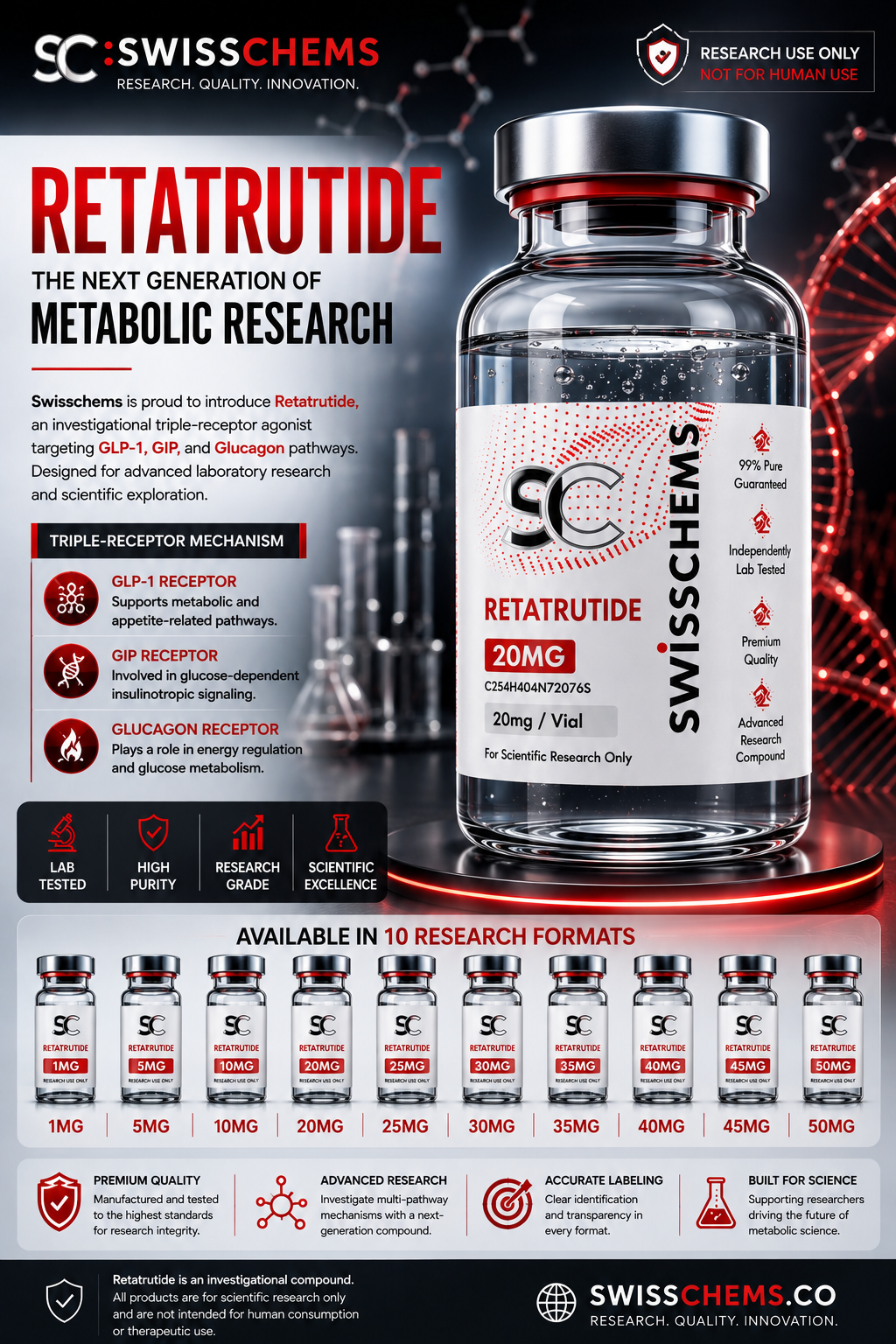
Retatrutide 1mg | 5mg | 10mg | 20mg | 25mg | 30mg | 35mg | 40mg | 45mg | 50mg
Together, these formats create a comprehensive buy Retatrutide vials online research lineup designed around clearly differentiated quantities and straightforward laboratory identification.
Important Research Notice: Retatrutide remains an investigational compound. The milligram quantities referenced throughout this page identify research-product formats only. They are not recommended doses, treatment protocols, or instructions for human administration.
What Is Retatrutide?
Retatrutide for sale usa is an investigational peptide-based compound being studied for simultaneous agonist activity involving three important metabolic receptor systems:
GLP-1 — Glucagon-Like Peptide-1
GIP — Glucose-Dependent Insulinotropic Polypeptide
Glucagon
This three-pathway mechanism is commonly described as triple-receptor agonism.
The scientific significance of this architecture extends beyond the compound itself.
It represents a broader direction within metabolic science: investigating whether coordinated activity across several biological pathways can produce different physiological effects compared with compounds acting primarily through one or two receptor systems.
That makes Retatrutide particularly relevant to researchers studying the next generation of metabolic signaling.
Why Retatrutide Is Generating Scientific Interest
Metabolic regulation does not depend upon a single biological pathway.
Energy balance, glucose regulation, endocrine signaling, nutrient processing, appetite-related signaling and other metabolic functions involve complex interactions between numerous biological systems.
This complexity has encouraged researchers to investigate multi-pathway compounds.
Retatrutide is particularly noteworthy because its pharmacological architecture combines activity at:
GLP-1 Receptors
GLP-1 receptor signaling has become a major area of metabolic research because of its relationship with glucose-dependent endocrine signaling, gastrointestinal physiology and appetite-related biological processes.
GIP Receptors
GIP represents another incretin pathway involved in metabolic and glucose-responsive signaling.
Its inclusion gives researchers another biological dimension through which multi-receptor activity can be studied.
Glucagon Receptors
Glucagon receptor signaling is involved in energy regulation and glucose metabolism.
Its incorporation alongside GLP-1 and GIP receptor activity is one of the characteristics distinguishing Retatrutide from earlier single- and dual-pathway research approaches.
Together, these three targets have made Retatrutide an important compound for studying the emerging science of triple metabolic receptor agonism.
Introducing the Complete Swisschems Retatrutide Research Range
Different experimental designs can require different quantities of research material.
Rather than restricting researchers to a single format, the Swiss Chems Retatrutide collection spans multiple labeled quantities.
Swisschems Retatrutide 1mg
Retatrutide 1mg represents the smallest quantity within the Swisschems Retatrutide research range.
It provides researchers with a clearly identified lower-quantity format for laboratory applications where only limited material is required.
Swisschems Retatrutide 5mg
Retatrutide 5mg provides another compact research format while expanding the quantity available beyond the introductory 1mg option.
The clearly differentiated labeling helps researchers identify and organize materials across experimental workflows.
Swisschems Retatrutide 10mg
Retatrutide 10mg provides a mid-range research quantity for laboratories requiring additional material.
As with every Swiss Chems Retatrutide format, the 10mg designation describes the quantity associated with the research product rather than a recommended human dosage.
Swisschems Retatrutide 20mg
Retatrutide 20mg expands the research range further and provides another clearly differentiated option for experimental environments requiring larger quantities.
Swisschems Retatrutide 25mg
Retatrutide 25mg extends the Swisschems research portfolio beyond the conventional lower-quantity formats.
The availability of intermediate quantities can provide researchers with greater flexibility when planning laboratory inventory and experimental requirements.
Swisschems Retatrutide 30mg
Retatrutide 30mg represents another higher-quantity format within the collection.
It is intended for legitimate laboratory and analytical research applications requiring an appropriately identified quantity of Retatrutide research material.
Swisschems Retatrutide 35mg
Retatrutide 35mg further expands the available research range.
By maintaining clearly separated quantities, Swisschems can provide researchers with greater flexibility when selecting materials appropriate for different experimental designs.
Swisschems Retatrutide 40mg
Retatrutide 40mg forms part of the higher-quantity segment of the Swiss Chems Retatrutide portfolio.
Clear identification becomes increasingly important across larger research formats, particularly where laboratories maintain multiple quantities of the same compound.
Swisschems Retatrutide 45mg
Retatrutide 45mg provides an additional research quantity positioned between the 40mg and 50mg formats.
Its inclusion helps create a broader spectrum of available quantities rather than forcing researchers into large jumps between product formats.
Swisschems Retatrutide 50mg
At the upper end of the current lineup is Swisschems Retatrutide 50mg.
The 50mg designation represents the quantity of research material associated with this format.
It does not indicate a recommended dose, increased effectiveness, medical superiority or suitability for human administration.
Swisschems Retatrutide Research Range at a Glance
| Research Format | Category |
|---|---|
| Retatrutide 1mg | Lower-quantity research format |
| Retatrutide 5mg | Lower-quantity research format |
| Retatrutide 10mg | Research format |
| Retatrutide 20mg | Research format |
| Retatrutide 25mg | Expanded research format |
| Retatrutide 30mg | Expanded research format |
| Retatrutide 35mg | Higher-quantity research format |
| Retatrutide 40mg | Higher-quantity research format |
| Retatrutide 45mg | Higher-quantity research format |
| Retatrutide 50mg | Highest listed research format |
Complete range: 1mg • 5mg • 10mg • 20mg • 25mg • 30mg • 35mg • 40mg • 45mg • 50mg
Retatrutide and the Evolution of Metabolic Research
Understanding the scientific importance of Retatrutide requires looking beyond a single compound.
The larger story concerns the evolution of metabolic research itself.
First Generation: Single-Pathway Investigation
Earlier research frequently concentrated on compounds targeting one primary receptor pathway.
This approach helped researchers characterize individual signaling mechanisms and establish foundational knowledge about metabolic regulation.
Second Generation: Dual-Pathway Investigation
Research subsequently expanded toward compounds capable of interacting with two complementary pathways.
Dual agonism introduced new questions concerning how simultaneous receptor activity could modify biological responses.
Emerging Generation: Triple-Pathway Investigation
Retatrutide represents another stage in this progression.
By combining activity involving GLP-1, GIP and glucagon receptors, researchers can investigate interactions among three distinct but metabolically relevant signaling pathways.
This does not automatically establish clinical superiority.
Instead, it creates a more complex and scientifically interesting research model.
Why Research-Grade Transparency Matters
As interest in emerging peptides grows, researchers must distinguish scientific documentation from marketing language.
A professional research supplier should prioritize transparency surrounding the identity and characterization of research materials.
Important considerations can include:
- Compound identification
- Labeled material quantity
- Batch or lot identification
- Analytical documentation
- Purity testing methodology
- Storage requirements
- Handling information
- Traceability
- Research-use designation
- Quality-control procedures
These elements help researchers understand exactly what is being supplied.
Analytical Documentation and Retatrutide Research
Analytical documentation can play an important role when evaluating research compounds.
Depending on the material and laboratory methodology, researchers may encounter analytical techniques such as high-performance liquid chromatography (HPLC) and mass spectrometry (MS) when examining compound identity or purity.
Documentation should always correspond to the actual material or batch being represented.
A generic certificate or purity statement should never be treated as a substitute for legitimate batch-specific analytical evidence.
For Swisschems Retatrutide products, any analytical documentation presented should therefore be evaluated according to the specific batch and testing information it actually supports.
Retatrutide vs Traditional GLP-1 Research
One reason searches surrounding Retatrutide research have increased is that the compound represents a different mechanistic approach from research centered exclusively on GLP-1 receptor activity.
Traditional GLP-1-focused research primarily examines one receptor family.
Retatrutide expands the research framework to three:
GLP-1 + GIP + Glucagon
This creates opportunities to investigate questions involving receptor interaction, metabolic signaling and multi-pathway pharmacology.
However, mechanistic complexity should not be confused with established clinical superiority.
Those conclusions require appropriate controlled research.
Swisschems and Responsible Research Positioning
Scientific credibility requires accurate terminology.
Retatrutide should be described according to its actual investigational status rather than being marketed as though it were an established consumer medication.
Accordingly, references such as:
Swisschems Retatrutide 1mg
Swisschems Retatrutide 5mg
Swisschems Retatrutide 10mg
Swisschems Retatrutide 20mg
Swisschems Retatrutide 25mg
Swisschems Retatrutide 30mg
Swisschems Retatrutide 35mg
Swisschems Retatrutide 40mg
Swisschems Retatrutide 45mg
and
Swisschems Retatrutide 50mg
should be understood as identifiers for different quantities of research material.
They should not be presented as clinical dosing protocols.
Frequently Asked Questions About Swisschems Retatrutide
What is Swisschems Retatrutide?
Swisschems Retatrutide refers to Retatrutide research formats included within the Swiss Chems research portfolio. Retatrutide is an investigational compound being studied for simultaneous activity involving GLP-1, GIP and glucagon receptors.
What Retatrutide quantities are listed by Swisschems?
The complete research lineup described here includes:
1mg, 5mg, 10mg, 20mg, 25mg, 30mg, 35mg, 40mg, 45mg and 50mg.
What makes Retatrutide scientifically different?
Its primary distinguishing characteristic is simultaneous agonist activity involving three metabolic receptor pathways:
GLP-1, GIP and glucagon.
This triple-receptor mechanism makes Retatrutide particularly relevant to research involving multi-pathway metabolic signaling.
Is Retatrutide the same as a traditional GLP-1 compound?
Not exactly.
Retatrutide includes GLP-1 receptor activity but is being investigated as a triple agonist involving GLP-1, GIP and glucagon receptors.
Is Retatrutide approved for human use?
Retatrutide remains investigational. Its research status should be distinguished from medicines that have received regulatory approval for specific clinical indications.
Does Retatrutide 50mg mean a 50mg human dose?
No.
The 50mg designation identifies the quantity of material associated with that research format. It should not be interpreted as a recommended human dose.
The same principle applies to every quantity described on this page.
Why does Swisschems offer multiple Retatrutide research formats?
Different laboratory projects can require different quantities of material. Offering multiple clearly identified formats can provide greater flexibility for research planning, inventory management and experimental requirements.
What is the largest Swisschems Retatrutide format listed?
The largest format covered in the current range is Retatrutide 50mg.
The Future of Triple-Receptor Research
Retatrutide illustrates how quickly metabolic research is advancing.
Scientific investigation has progressed from studying isolated receptor pathways toward understanding increasingly complex combinations of biological signals.
The transition from:
Single agonism → Dual agonism → Triple agonism
represents an important evolution in experimental metabolic science.
Retatrutide sits at the center of that emerging research landscape because it provides scientists with a model for investigating coordinated activity across three metabolically significant receptor systems.
Its ultimate scientific and clinical significance will depend on the quality of ongoing research, reproducible evidence and appropriate regulatory evaluation.
Swisschems Retatrutide: Built Around Research, Transparency and Scientific Progress
The introduction of Retatrutide marks a significant expansion of the Swisschems research portfolio.
With research formats spanning:
1mg → 5mg → 10mg → 20mg → 25mg → 30mg → 35mg → 40mg → 45mg → 50mg
the Swiss Chems Retatrutide collection provides researchers with one of the broadest quantity structures within the portfolio.
More importantly, Retatrutide buy represents the direction modern metabolic science is moving: toward increasingly sophisticated investigation of interconnected biological pathways.
For researchers studying GLP-1, GIP, glucagon signaling, triple-receptor agonism, metabolic pathways and emerging peptide science, Retatrutide represents an important investigational compound to watch.
Swisschems continues to expand its research catalog around emerging compounds while emphasizing clear product identification, responsible research positioning and scientific transparency.