When researching Swisschems or Swiss Chems, one of the most important topics to understand is product testing. In the research chemical market, professional presentation alone is not enough. Researchers need documentation that helps them evaluate identity, purity, batch consistency, and analytical quality.
That is why searches for terms such as Swisschems COA, Swiss Chems lab testing, Swisschems purity testing, and Swisschems research compounds continue to attract attention.
This guide explains what a Certificate of Analysis means, how laboratory testing can support research transparency, and what researchers should look for when evaluating Swiss Chems research materials in 2026.
What Is a Swisschems COA?
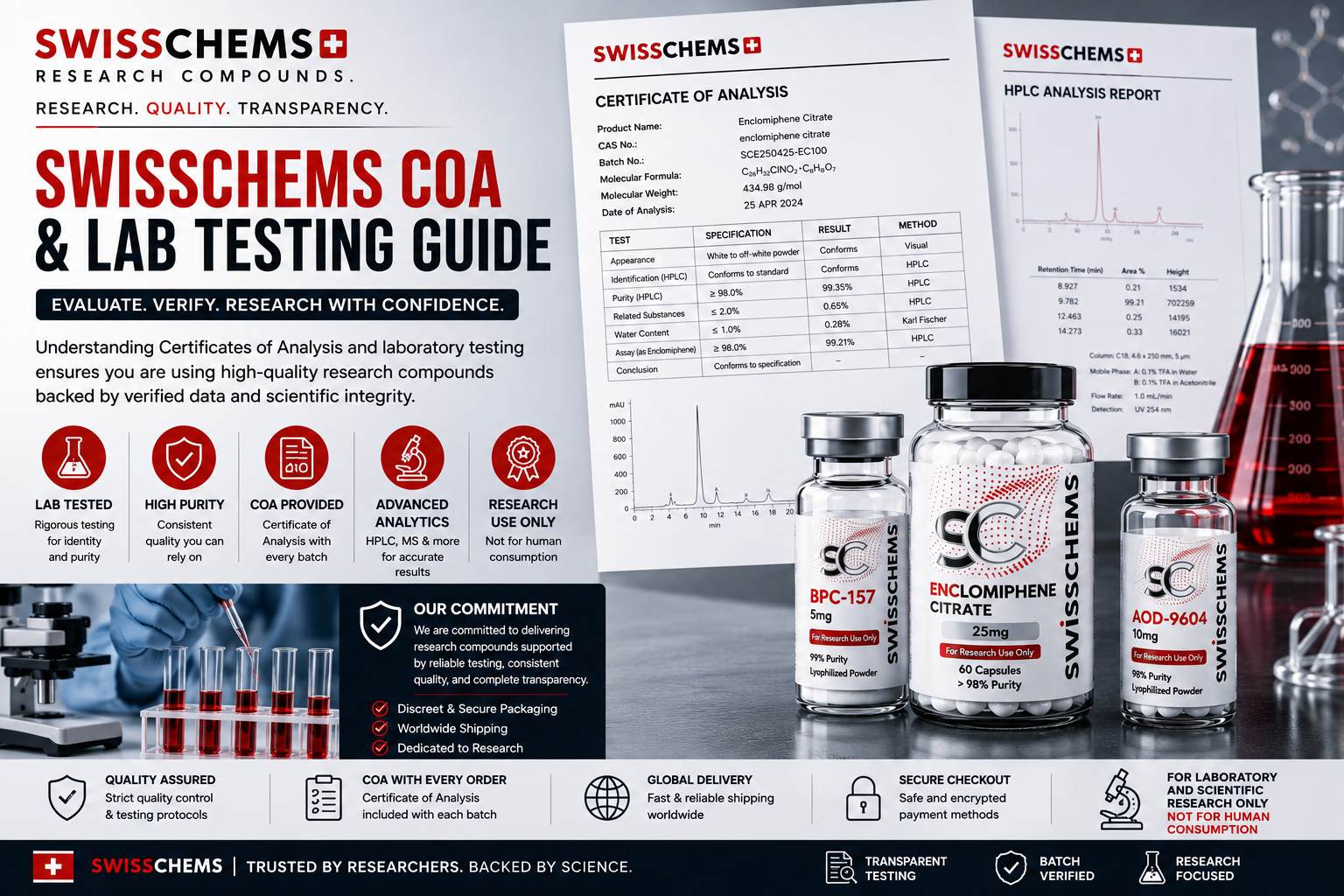
A Swisschems COA refers to a Certificate of Analysis associated with a research compound.
A Certificate of Analysis is a laboratory document that can summarize the results of analytical testing performed on a material. Depending on the compound and laboratory methodology, a COA may include information about identity, purity, batch number, analytical method, and other measurable characteristics.
For researchers, the value of a COA depends on how specific and verifiable the information is.
A professional COA should ideally connect the laboratory results to the exact research material being evaluated.
Why Swiss Chems Lab Testing Matters
Swiss Chems lab testing is important because research reliability depends heavily on the quality of the materials being studied.
If researchers cannot confidently identify a compound, experimental results may become harder to interpret.
Testing can help answer questions such as:
- Does the sample correspond with the stated compound?
- What analytical methods were used?
- Is the tested material linked to a particular batch?
- Does the documentation contain sufficient information for scientific evaluation?
These questions are relevant not only to Swisschems, but to any research chemical supplier.
Swisschems Research Compounds and Quality Documentation
The term Swisschems research compounds can refer to a range of materials associated with scientific and laboratory research.
Different compounds may require different analytical techniques.
For example, one material may be evaluated using chromatography, while another may require additional methods for stronger confirmation.
This means researchers should avoid treating all COAs as identical.
The analytical method should make sense for the substance being tested.
Understanding Swisschems Purity Testing
Swisschems purity testing is another topic commonly associated with research product quality.
Purity is usually expressed as a percentage, but the percentage itself does not tell the entire story.
Researchers should also consider:
The analytical method: How was the purity estimate obtained?
The laboratory: Who performed the analysis?
The batch: Does the test correspond to the actual product batch?
The date: Is the documentation reasonably current?
The sample identity: Does the report clearly identify the material being tested?
A purity percentage becomes more useful when these supporting details are available.
HPLC and Swiss Chems Research Compounds
High-performance liquid chromatography, commonly abbreviated as HPLC, is widely used in analytical chemistry.
HPLC can help separate different components within a sample and provide useful information about sample composition.
Researchers reviewing Swisschems HPLC testing should look beyond a single headline number.
Useful analytical reports may include chromatograms, peak information, test conditions, and clear sample identification.
The exact information required depends on the compound and intended research purpose.
Mass Spectrometry and Compound Identification
Mass spectrometry is another analytical technique that can help researchers characterize chemical substances.
When properly used, it can provide information related to molecular identity.
For some research materials, combining analytical methods can provide stronger evidence than relying on a single test.
Researchers evaluating Swiss Chems research compounds should therefore consider whether the available testing approach is appropriate for the particular compound.
Batch-Specific Testing: Why It Matters
Batch traceability is one of the most important quality signals in research chemical documentation.
A laboratory report is more useful when it can be linked to the exact batch of material being evaluated.
Researchers should look for matching information such as:
- Batch or lot number
- Product name
- Sample identifier
- Test date
- Laboratory information
- Analytical results
Without clear batch traceability, it may be difficult to determine whether a report actually represents the material being examined.
Swisschems COA vs Generic Purity Claims
There is an important difference between a documented analytical result and a marketing statement.
A phrase such as “99% purity” is a claim.
A detailed Swisschems COA containing relevant analytical information can provide evidence supporting that claim.
Researchers should therefore prioritize measurable documentation over promotional language.
This approach makes supplier evaluation more objective.
How to Read a Swiss Chems Certificate of Analysis
When examining a Swiss Chems Certificate of Analysis, researchers can focus on several sections.
Product Identification
The compound should be clearly named.
Batch Number
The document should ideally contain a batch or lot number that can be matched to the research material.
Analytical Method
The COA should indicate how the sample was evaluated.
Results
The document should clearly present the laboratory findings.
Laboratory Information
Researchers should determine which laboratory performed the analysis where that information is available.
Test Date
Testing dates can provide context regarding how current the documentation is.
Together, these details can help researchers judge how useful the COA is.
Swisschems Reviews vs Laboratory Evidence
Swisschems reviews can provide information about practical customer experiences, but they should not replace scientific evidence.
Reviews may be useful for learning about communication, packaging, support, or general order reliability.
However, customer feedback cannot independently establish chemical purity.
When evaluating product quality, analytical documentation should carry more weight than testimonials.
Is Swisschems Legit? Use Evidence, Not Assumptions
The question “Is Swisschems legit?” is commonly searched online.
A more useful way to approach this question is to evaluate multiple objective signals.
Researchers can examine:
- Transparency of product information
- Availability of analytical documentation
- Batch-specific testing
- Professional labeling
- Consistency between claims and test results
- Quality of available COAs
- Independent information
- Regulatory considerations
No single signal proves everything, but a combination of transparent documentation and verifiable information can provide a stronger basis for evaluation.
Swisschems Quality Control in 2026
Research chemical quality control is becoming increasingly important.
Researchers expect better documentation, clearer batch identification, and more transparent analytical evidence.
For Swisschems quality control, the most meaningful indicators are those that can be independently reviewed.
Professional packaging and branding may improve presentation, but laboratory documentation provides the stronger scientific foundation.
Swiss Chems Research Products: What Researchers Should Check
Before relying on any research compound, researchers should examine several quality indicators.
A strong evaluation process may include checking the compound identity, reviewing the COA, confirming batch information, examining the analytical method, reviewing storage requirements, and verifying the regulatory status of the material.
This approach can help researchers make more informed decisions when evaluating Swiss Chems research products.
Why Transparency Matters for Swisschems Research Chemicals
Transparency is especially important in the research chemical sector because laboratories depend on reproducibility.
If researchers do not know exactly what material they are using, experimental uncertainty increases.
Transparent documentation can help reduce that uncertainty.
For this reason, Swisschems research chemicals should be evaluated through clear product information, analytical evidence, and traceable documentation.
Frequently Asked Questions About Swisschems COAs and Testing
What does Swisschems COA mean?
Swisschems COA refers to a Certificate of Analysis associated with a Swisschems research material.
Why is a COA important?
A COA can provide analytical information about the identity, purity, and characteristics of a research compound.
Does a high purity percentage prove quality?
Not by itself. Researchers should also consider the test method, laboratory, batch information, and the documentation supporting the result.
What is Swiss Chems lab testing?
Swiss Chems lab testing refers to analytical testing associated with research compounds marketed under the Swisschems or Swiss Chems name.
Should every research compound use the same testing method?
No. Different compounds may require different analytical techniques.
Are Swisschems reviews enough to determine purity?
No. Customer reviews can describe experiences, but they cannot independently verify chemical purity.
What should researchers look for in a Swisschems COA?
Researchers should look for clear product identification, batch information, test date, analytical method, laboratory information, and clearly reported results.
Final Thoughts on Swisschems COA and Lab Testing
The most important thing to understand about Swisschems COA documentation and Swiss Chems lab testing is that research quality should be evaluated through evidence.
Brand recognition can generate interest, but analytical documentation provides the information researchers need to assess research materials more objectively.
Clear product identification, batch traceability, relevant analytical methods, transparent COAs, and responsible research standards all contribute to a stronger evaluation process.
As research chemical markets continue to evolve in 2026, researchers examining Swisschems research compounds should prioritize documentation that is specific, traceable, and scientifically meaningful.