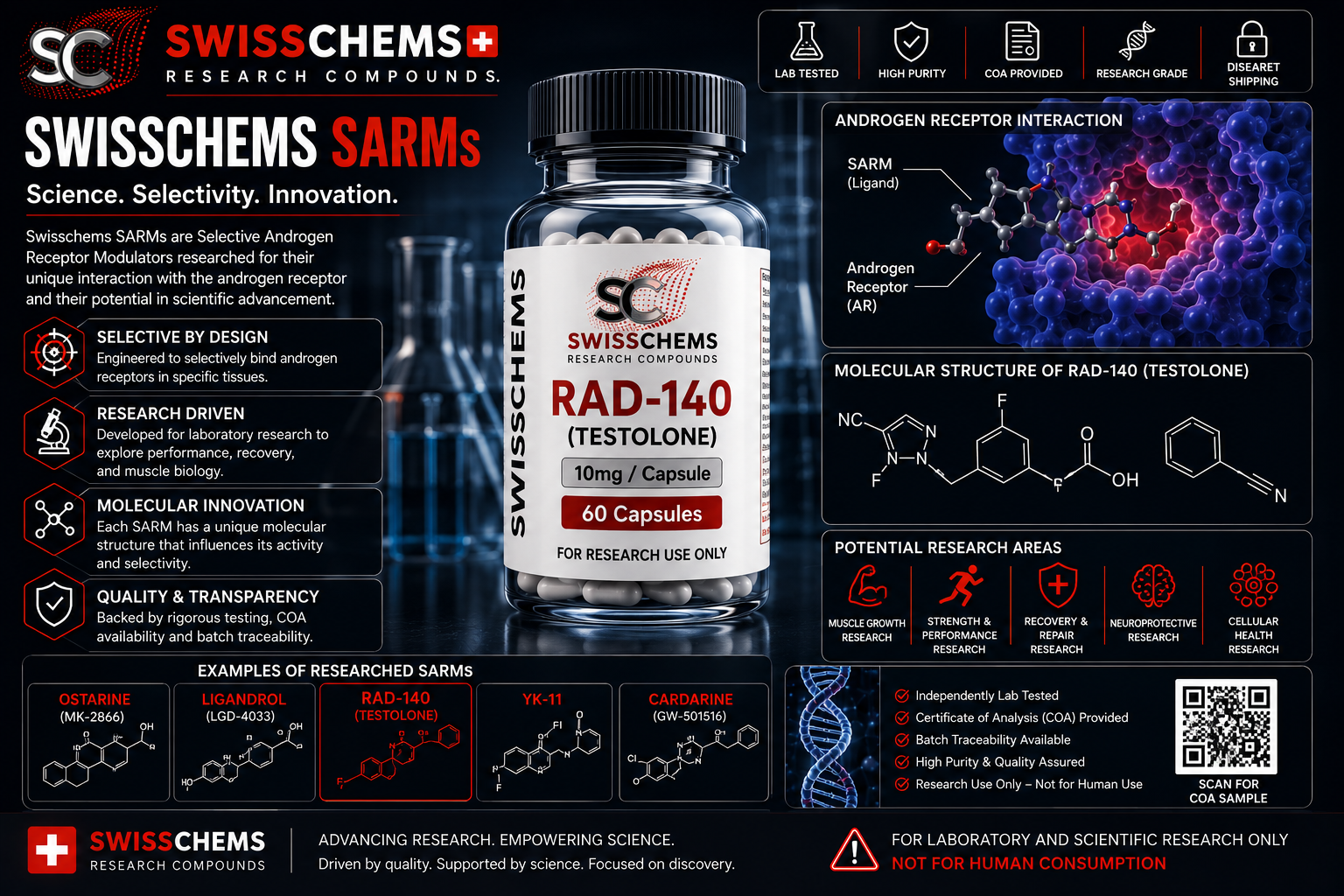
When people encounter the term Swisschems SARMs, attention often goes immediately to the word “SARMs.” Scientifically, however, the more interesting story begins one level deeper—with the molecular structure of each individual research compound.
Two compounds can appear within the same broad research category while possessing substantially different chemical structures, molecular properties, experimental histories, and interactions with biological systems.
That makes Swisschems SARMs an interesting entry point into a larger scientific subject: how molecular architecture influences experimental behavior.
Rather than another standard guide to SARMs, this article explores the chemistry behind the category and explains why researchers should evaluate molecules individually.
What Are Swisschems SARMs?
Swisschems SARMs generally refers to selective androgen receptor modulators associated with Swisschems and the specialized research-compound market.
SARM stands for selective androgen receptor modulator.
These experimental compounds have been investigated because of their interactions with the androgen receptor, a protein involved in androgen signaling.
But describing a molecule as a SARM does not tell researchers everything about it.
The individual chemical structure remains extremely important.
Swisschems SARMs Are a Category, Not a Single Compound
Think about the word “vehicle.”
A motorcycle, truck, and electric car can all be classified as vehicles, yet their engineering and behavior are completely different.
A similar principle applies to Swisschems SARMs.
The category provides researchers with a broad pharmacological relationship, but individual compounds can differ considerably.
Researchers therefore need to move beyond:
“This is a SARM.”
The more useful scientific question is:
“Which molecule is this, and what characteristics distinguish it from other molecules in the category?”
The Molecular Architecture Behind Swisschems SARMs
Every research compound has a chemical structure.
That structure determines properties such as molecular shape, molecular weight, functional groups, polarity, solubility, and potential interactions with other molecules.
Even relatively small structural differences can sometimes substantially alter experimental behavior.
This is one reason researchers studying Swisschems SARMs should not automatically extrapolate observations involving one compound to another.
Chemical similarity does not guarantee identical biological behavior.
Swisschems SARMs and Structure-Activity Relationships
Medicinal chemists frequently investigate something called a structure-activity relationship, or SAR.
Despite the similar abbreviation, SAR is different from SARM.
Structure-activity relationship research examines how modifications to a molecule’s chemical structure influence its observed biological activity.
Researchers might compare several related experimental compounds and investigate whether structural differences correspond with changes in receptor interactions or other measurable properties.
A simplified model is:
Chemical Structure → Molecular Interaction → Biological Signal → Experimental Observation
This scientific framework provides a particularly useful way to understand Swisschems SARMs research.
Why Small Molecular Changes Can Matter
Imagine researchers modify one part of an experimental molecule.
The new molecule may look extremely similar to the original on paper.
Yet that small modification could potentially affect properties such as receptor affinity, metabolic stability, solubility, or interaction with other molecular systems.
This is why medicinal chemistry can involve investigating large libraries of structurally related molecules.
Researchers are effectively asking:
Which structural characteristics influence the behavior we are studying?
For Swisschems SARMs, understanding individual molecular identity is therefore more informative than relying solely on category labels.
Swisschems SARMs and Receptor Binding
SARMs are studied primarily in connection with the androgen receptor.
But receptor binding itself is a sophisticated molecular process.
A compound’s three-dimensional characteristics can influence how it interacts with a receptor’s binding environment.
Researchers may investigate binding affinity and subsequent receptor behavior using appropriate experimental techniques.
Importantly, detecting receptor interaction does not automatically establish clinical effectiveness or safety.
It establishes information about a particular experimental interaction.
Keeping those conclusions separate is essential when interpreting Swisschems SARMs research.
Swisschems SARMs and Molecular Selectivity
The concept of selectivity is central to SARM research.
Researchers have investigated whether different molecular structures can produce differentiated patterns of androgen-receptor activity.
But selectivity should not be oversimplified.
Biological responses can depend on the compound, experimental model, receptor environment, metabolism, concentration, and numerous downstream signaling processes.
Therefore, describing Swisschems SARMs as “selective” should not be interpreted as meaning that the molecules interact with only one tissue or are automatically free from unwanted effects.
Those conclusions require separate evidence.
Swisschems SARMs and Experimental Concentration
Another important concept is concentration.
A biological response observed at one experimental concentration may differ from observations made at another.
Researchers frequently construct dose-response relationships to examine how changing experimental concentrations affects measured outcomes. swisschems
This provides considerably more information than testing only one concentration.
When scientific literature concerning compounds associated with Swisschems SARMs is evaluated, experimental concentration is therefore an important part of interpreting the findings.
Swisschems SARMs and Analytical Chemistry
Before studying what a research material does biologically, researchers need information about what the material actually is.
This is where analytical chemistry enters the picture.
Depending on the compound, researchers may use techniques such as:
- HPLC
- LC-MS
- Mass spectrometry
- NMR spectroscopy
- Other validated analytical techniques
Different analytical methods answer different questions.
For researchers evaluating Swisschems SARMs, the phrase “lab tested” is therefore less informative than knowing which test was performed and what the resulting data actually demonstrated.
Swisschems SARMs and Chemical Identity
Identity is one of the most fundamental analytical questions.
A sample could theoretically contain highly pure material while still not contain the expected molecule.
Researchers may therefore examine identifiers such as the compound name, molecular formula, molecular weight, CAS number, structural information, and appropriate analytical results.
For Swisschems SARMs, chemical identity and purity should be viewed as related but separate considerations.
Swisschems SARMs and Batch Traceability
Research materials can be produced in different batches.
A batch identifier can help researchers distinguish one production lot from another and connect a particular material with relevant analytical records.
A useful research trail could look like:
Swisschems SARM → Compound Identity → Batch Number → Analytical Data → Experiment → Results
This type of documentation can become especially important when laboratories attempt to reproduce previous experiments.
Swisschems SARMs and Research Reproducibility
Reproducibility is one of science’s most important principles.
If another laboratory repeats an experiment under sufficiently comparable conditions, researchers should ideally be able to investigate whether comparable findings emerge.
For Swisschems SARMs research, reproducibility can depend on documenting variables such as the specific compound, relevant batch, analytical characterization, experimental concentration, storage conditions, protocol, and measurement methodology.
Better records make scientific comparisons stronger.
Swisschems SARMs and Computational Chemistry
Modern SARM research is no longer confined to physical laboratory experiments.
Computational chemistry can help researchers model molecular structures and generate hypotheses about potential interactions.
Scientists can compare large libraries of candidate molecules before selecting particular compounds for further investigation.
Artificial intelligence is making these computational approaches increasingly sophisticated.
This creates a modern discovery cycle:
Digital Molecular Design → Computational Prediction → Compound Synthesis → Analytical Verification → Laboratory Testing → Experimental Data
Swisschems SARMs exist within the broader scientific landscape created by this type of research.
Swisschems SARMs and AI-Assisted Research
Artificial intelligence is increasingly being explored for molecular research.
AI systems can help scientists analyze enormous chemical datasets, identify structural patterns, predict molecular properties, and prioritize potential experimental candidates.
But predictions remain predictions.
Physical experiments are still required to test whether computational hypotheses correspond with observable reality.
The relationship is complementary:
AI proposes possibilities. Experimental science investigates them.
This intersection between computational discovery and laboratory validation could become increasingly important to future SARM research.
Swisschems SARMs and Scientific Evidence
Researchers should also consider the level of evidence behind claims involving individual Swisschems SARMs.
Scientific evidence can progress through very different stages:
Computational modeling → Laboratory assays → Cellular research → Preclinical investigation → Clinical research
Evidence from one level should not automatically be treated as evidence from another.
For example, an interesting cellular observation does not establish a clinical outcome.
This distinction is particularly important for experimental compounds.
Are Swisschems SARMs Approved for Human Use?
Many compounds commonly categorized as SARMs remain experimental and are not approved for routine human use.
Regulatory status should be checked individually because rules and classifications can differ by compound and jurisdiction.
A research material being analytically characterized does not establish that it is medically safe.
Likewise, a high reported purity percentage does not establish clinical efficacy.
Researchers investigating Swisschems SARMs should keep four questions separate:
Identity
Purity
Experimental activity
Clinical safety and approval
Each requires different evidence.
A Better Way to Research Swisschems SARMs
Instead of asking only whether Swisschems SARMs are good, researchers can ask more scientifically useful questions.
What is the exact molecule?
What structural characteristics distinguish it?
What is known about its interaction with the androgen receptor?
Which experimental models produced the available evidence?
How was the research material analytically characterized?
Can the material be traced to a particular batch?
Are conclusions being drawn from laboratory evidence or clinical evidence?
What is the compound’s current regulatory status?
These questions produce a substantially more meaningful understanding of Swisschems SARMs.
Frequently Asked Questions About Swisschems SARMs
What are Swisschems SARMs?
Swisschems SARMs generally refers to selective androgen receptor modulators associated with Swisschems and intended or marketed for experimental research.
Are all Swisschems SARMs chemically similar?
They belong to a related research category, but individual compounds can have different molecular structures and experimental characteristics.
Why does molecular structure matter in Swisschems SARMs?
Molecular structure can influence physical properties, receptor interactions, metabolism, stability, and other experimentally relevant characteristics.
What does selective mean in SARMs?
Selectivity relates to differentiated patterns of receptor activity investigated experimentally. It should not be interpreted as meaning that a compound acts exclusively in one tissue or is automatically safe.
How are Swisschems SARMs analyzed?
Appropriate analytical techniques depend on the compound and research objective. Methods can include chromatography, mass spectrometry, spectroscopy, and other validated laboratory approaches.
Does purity prove that Swisschems SARMs are safe?
No. Chemical purity does not establish clinical safety, efficacy, or regulatory approval.
Final Thoughts on Swisschems SARMs
The phrase Swisschems SARMs describes a category.
The science happens at the molecular level.
Every individual compound has its own structure, analytical characteristics, experimental history, receptor interactions, and evidence base.
That is why the strongest approach to researching Swisschems SARMs is not to ask what SARMs do as though they were one molecule.
Instead, ask:
How does this particular molecular structure influence this particular biological system under these particular experimental conditions?
That single question opens the door to medicinal chemistry, receptor biology, analytical science, computational modeling, AI-assisted discovery, and experimental pharmacology.
And that is what makes the science surrounding Swisschems SARMs far more interesting than the category name alone.